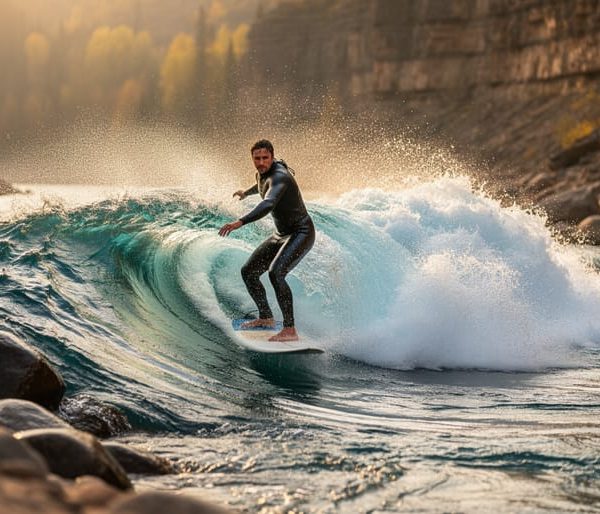
Surfing the zuvuya means riding the river’s living memory, a Mayan concept describing the circular path where past, present, and future converge in a single moment. When you’re locked into a standing wave, time collapses. The water rushing beneath your board has traveled from distant mountains, carries the force of yesterday’s storm, and will continue downstream long after you paddle out. You’re not moving through space like ocean surfers chasing swells. You’re holding position in a moving universe, and that paradox changes everything about how you relate to the wave, the river, and yourself.
The zuvuya isn’t some mystical abstraction borrowed to sound profound. It’s the most accurate description of what makes river surfing fundamentally different from its river vs ocean cousin. Ocean waves come and go. River waves stay put while thousands of gallons flow through them every second. You can surf the same hydraulic feature morning and night, in different seasons, as a beginner and years later as an expert. The wave remembers you. You build a relationship with a specific piece of moving water that ocean surfers, always hunting the next break, rarely experience.
This circular, timeless quality attracts a certain type of surfer to rivers. People who want more than adrenaline. Who crave the meditative repetition of returning to the same spot, reading subtle changes in flow, understanding how last week’s rainfall shifted the hole’s shape. River surfers become students of place rather than hunters of conditions. That’s surfing the zuvuya: recognizing that every session connects you to every other session, that the river is both teacher and wave, and that standing still in rushing water might be the most dynamic thing you’ll ever do.
What Does ‘Zuvuya’ Actually Mean?
Before we dive into how this connects with river surfing, let’s get clear on what we’re actually talking about. The word “zuvuya” comes from Mayan cosmology, and if you’re picturing some mystical woo-woo, hang with me, this concept is surprisingly practical once you understand it.
In Mayan thought, zuvuya describes a circuit or pathway that loops through time and memory. Think of it less like a straight timeline (where Monday leads to Tuesday leads to Wednesday) and more like a circular track where different moments can meet and overlap. Past experiences, present actions, and future possibilities aren’t separate boxes, they’re all accessible points on the same circuit.
The key insight? Time isn’t just forward motion. It’s also recursive, cyclical, a returning path. When you step onto the zuvuya, you’re entering a space where memory informs the present moment, where what you’re experiencing now echoes what came before and shapes what comes next, all simultaneously.
For the Mayans, this wasn’t abstract philosophy. It was how they understood lived experience, the way certain moments feel familiar even when they’re new, how patterns repeat across generations, how wisdom from the past can suddenly illuminate the present.
Now here’s where it gets interesting for river surfers: you’re already experiencing this, whether you call it zuvuya or not. Every time you paddle back to that same standing wave, you’re not starting fresh, you’re stepping onto a circuit. Yesterday’s rides inform today’s adjustments. The muscle memory from this morning’s session shapes this afternoon’s flow. You’re riding the same wave, but never the same experience, cycling through variations on a theme that connects every session you’ve ever had on that particular feature.
The river surfer who paddles out to their local wave daily isn’t just repeating an activity. They’re walking the zuvuya, tracing a circuit where each ride builds on every other, where past and present merge in the eternal now of the standing wave.
The River Wave as a Portal: How Standing Waves Create the Zuvuya Experience
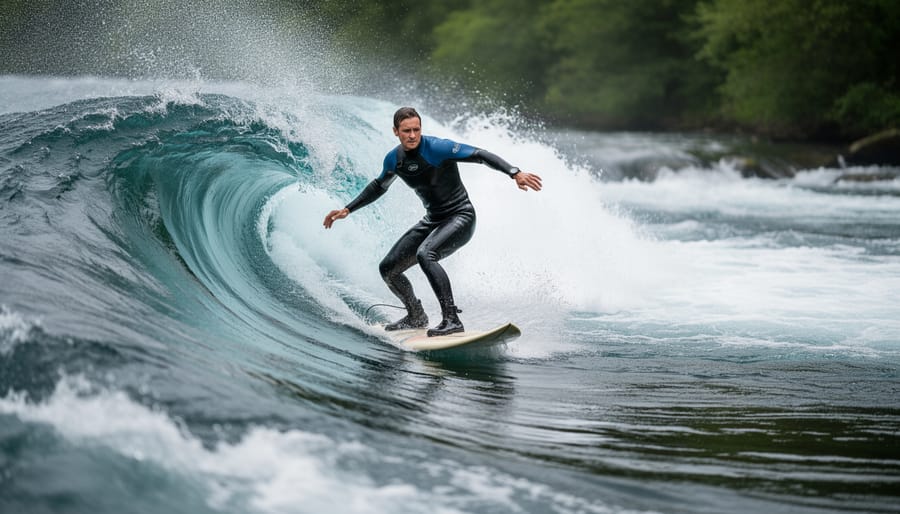
The Eternal Now: Riding Without Forward Motion
On an ocean wave, you’re racing toward shore, committed to a trajectory that ends in whitewater or a graceful exit. On a river wave, you go absolutely nowhere, and that’s where the magic lives. The water rushes beneath you at maybe eight miles per hour, but your board stays locked in the same six-foot pocket, carving and adjusting while the world flows past. It’s not like ocean surfing in the most fundamental way: the wave becomes a stage instead of a vehicle.
This stationary riding rewires your brain’s time perception. Without the forward motion marking progress, without the countdown to closeout, you lose the usual temporal anchors. Five minutes can feel like thirty seconds when you’re dialed in, or a thirty-second ride can expand into what feels like an entire session’s worth of experience. You’re not tracking distance traveled or waves caught per hour, those metrics become meaningless. Instead, you’re measuring depth: how fully you inhabit each microsecond of adjustment, each weight shift, each subtle read of the hydraulic.
River surfers describe entering a trance state after the first minute on a good wave. Your conscious mind stops narrating moves and your body takes over, responding to feedback loops measured in milliseconds. The wave pushes, you counter, it responds to your counter, you adjust to its response, an infinite conversation with no beginning or end, just continuous present-tense dialogue.
Memory and Muscle: The Body’s Cyclical Learning
River surfing rewrites how your body learns. In the ocean, you get one shot at a move before the wave collapses and you’re paddling back out, replaying what just happened in your head. On a standing wave, your next attempt starts the moment your last one ends. Fall off a cutback? You’re back on the wave in seconds, muscle memory still warm, adjusting before the sensation fades.
This immediate feedback loop creates what neurologists call “spaced repetition”, the most effective pattern for embedding skills into your nervous system. Your body doesn’t just remember the successful moves; it remembers the failures and micro-adjustments between them. That slight weight shift that finally locked in your bottom turn? Your muscles learned it through twenty attempts in ten minutes, not twenty sessions spread across a season.
The cyclical nature goes deeper than just practice efficiency. River surfers often describe entering a trance state where conscious thought dissolves and the body takes over, refining technique through pure sensation rather than analysis. You’re not thinking “shift weight to back foot, rotate shoulders, extend through the turn.” You’re feeling the wave’s pressure, responding, feeling again, responding again, a conversation between water and muscle that happens faster than language.
This is the zuvuya at the cellular level: your body moving through loops of action and reaction until technique becomes instinct, until the wave and you are cycling together.
River Surfing’s Cyclical Culture: Community as Zuvuya
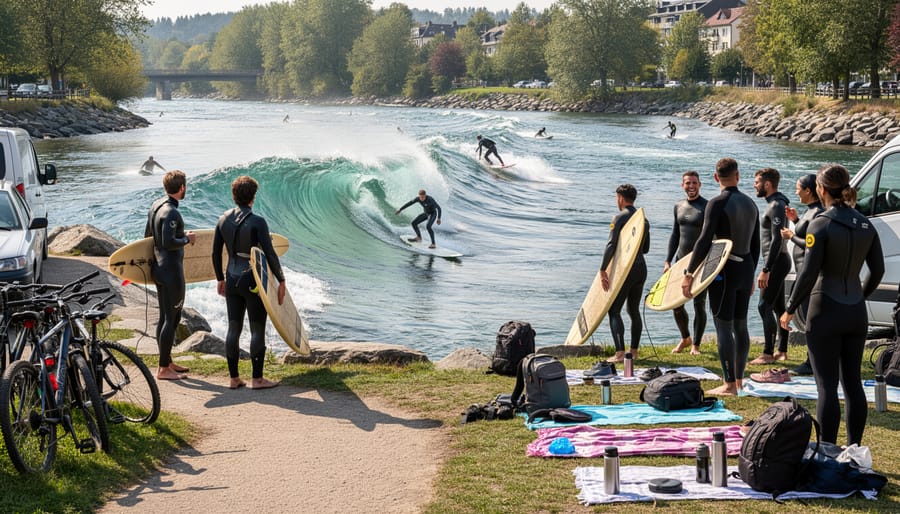
Ocean surfers chase swells and follow forecasts, but river surfers return to the same coordinates season after season, year after year. This geographic permanence creates a culture that mirrors the zuvuya itself, a circuit of familiar faces, seasonal rhythms, and accumulated shared memory that distinguishes river surfing from its saltwater cousin.
Walk up to any established river wave on a weekday morning and you’ll see it: the same trucks in the parking lot, the same surfers nodding hello before paddling out, the same rotation forming without anyone needing to discuss it. Unlike ocean breaks where lineups shift constantly with traveling surfers and swell chasers, river waves develop crews who return daily, sometimes for decades. They’re not checking conditions, they know the wave will be there. They’re showing up for the ritual, the practice, the community that forms when place stays constant and people cycle through the same space repeatedly.
The river itself reinforces this cyclical pattern. Spring runoff transforms gentle summer waves into churning monsters. Fall brings low flows and different formations. Winter freeze-ups pause the cycle entirely in some regions, creating anticipation for the season’s return. River surfers don’t just chase conditions, they live through the full cycle, experiencing their wave in all its seasonal personalities. This creates a different relationship with progression and mastery. You’re not just learning a wave; you’re learning a living system that changes and returns, teaching different lessons each season while remaining fundamentally itself.
These patterns weave the zuvuya into daily river surfing life:
- The morning crew who’ve shared dawn sessions for years, knowing each other’s lines and boundaries without speaking
- Seasonal flows that transform the same geographic feature into entirely different waves throughout the year
- Annual high-water formations that appear predictably, creating reunion moments for surfers who gather specifically for these temporary features
- Multi-generational locals where parents teach children on the same wave they learned on, decades apart
This permanence breeds deeper community bonds than most ocean breaks sustain. When you know you’ll see the same people tomorrow and next month and next year, interactions shift from transient competition to long-term relationships. Sharing knowledge becomes investment in your community rather than giving away beta to strangers. The wave becomes a meeting place, a classroom, a shared home that connects generations of surfers through recurring experience. The zuvuya isn’t just something you ride, it’s the cultural pattern your community creates through consistent return to sacred geography.
Voices from the Current: River Surfers on the Zuvuya Experience
When you ask longtime river surfers about that moment when time seems to stop, most pause, not because they don’t know what you mean, but because the experience lives beyond easy description.
Sarah Chen has been surfing Munich’s Eisbach wave for twelve years. “My first ocean surf trip after discovering river waves felt wrong,” she says. “I kept chasing the next ride, the next peak, like I was supposed to be getting somewhere. On the river, I’d learned that you don’t go anywhere, and that’s exactly the point. You’re in conversation with the same wave, the same moves, refining them over months and years. There’s no finish line, just deeper understanding.”
Chen describes sessions where an hour passes like ten minutes, yet she remembers every micro-adjustment, every weight shift. “It’s cyclical memory. I can feel ghost traces of last week’s session in my body, last season’s breakthroughs. They all layer together in the present moment.”
For newcomers, this perception shift can be disorienting before it becomes liberating. Jake Morrison started river surfing six months ago at Boise’s Whitewater Park after a decade of ocean surfing. “At first, I thought riding the same wave repeatedly would be boring. Then around week three, something clicked. I stopped thinking about my next move and started feeling the conversation between my board and the hydraulic. That’s when time got weird, in the best way.”
Morrison credits flow state tips he learned from locals with accelerating his access to what Chen calls “the timeless zone.” He notes that the immediate feedback loop of river waves creates a learning cycle that feels ancient and intuitive rather than modern and analytical.
Veteran surfer Tom Bowker, who helped establish Calgary’s river surf community twenty years ago, offers perspective on how this experience deepens with time. “Your first year, you’re learning tricks. Your fifth year, you’re forgetting tricks and just riding. The river becomes meditation. I’ve had sessions where I couldn’t tell you what maneuvers I did, but I could tell you what the water taught me about presence.”
This river-specific approach to progression, circular rather than linear, depth over distance, resonates across experience levels, creating a community united not by skill level but by shared recognition of something larger than sport.
Practical Magic: How to Enter the Zuvuya on Your Wave
For Beginners: Finding Your First Timeless Moment
You don’t need perfect cutbacks to touch the zuvuya. Your first timeless moment often arrives when you stop trying so hard.
Start with commitment to the pop-up. New river surfers tend to hesitate, analyzing the wave mid-transition. Instead, trust your muscle memory from practice and stand decisively. That split-second of full commitment opens a small window where thought drops away.
Focus on one physical anchor, your front knee bend, your shoulder alignment, or the feel of water under your board. When your mind wanders to what you should be doing next, return to that single sensation. This isn’t meditation practice; it’s riding meditation.
Let go of your mental scoreboard. Beginners often count seconds or mentally critique each wobble. The zuvuya appears in the space between those thoughts. If you fall, climb back on without replaying the mistake. The wave hasn’t moved, you get another chance immediately.
Notice when fifteen seconds feels like three minutes. That distortion signals you’ve entered the flow. It might last only a moment your first time, but you’ll recognize it: a sudden ease, everything slowing down, your body responding before you think.
Where Past and Future Meet: The Evolution of River Surfing Through the Zuvuya Lens
River surfing sits at a peculiar crossroads in wave-riding history. While ocean surfers chase swells generated thousands of miles away, river surfers return to the same hydraulic feature day after day, year after year. This circular practice mirrors how ancient Polynesians approached wave riding, not as conquest or collection, but as relationship and ritual.
The zuvuya lens reveals river surfing as both throwback and innovation. Early Hawaiians rode the same reef breaks for generations, developing intimate knowledge of every swell pattern and seasonal shift. River surfers do the same, but compress that generational learning into single seasons. You ride Munich’s Eisbach or Calgary’s Kananaskis through spring runoff, summer low flow, and autumn transitions, watching your wave transform yet remain essentially itself.
This permanence creates something ocean surfing lost as it modernized: a deep, place-based practice. The surfer who returns to Habitat 67 in Montreal for five consecutive winters knows that wave more intimately than most ocean surfers will ever know any single break. That knowledge isn’t just technical. It’s temporal, emotional, cyclical, exactly what the ancient concept of zuvuya describes.
Yet river surfing pioneers entirely new territory. It’s invented wave parks where hydraulics never existed, adapted ocean maneuvers to stationary flows, and built communities around industrial structures. The future of surfing might involve more created waves than natural ones, and river surfers are writing that playbook. They know the differences between river and ocean aren’t limitations but invitations to evolve the sport.
Standing waves let us honor surfing’s sacred origins while pushing toward its engineered future. Past and future aren’t separate here, they’re both present in every session, every return to the same spot, every moment of timeless flow on a wave that goes nowhere yet takes you everywhere.
The zuvuya isn’t some mystical experience reserved for advanced riders or those who’ve spent years on the water. It’s there, waiting in every standing wave, in every moment you choose to truly be present rather than just going through the motions.
You’ve learned what the zuvuya means and how river surfing’s unique nature creates a natural portal into this circular, timeless state. You’ve seen how our community embodies these cycles, returning to the same spots, sharing waves across seasons, learning and relearning in that eternal now. The philosophical and practical merge here, where ancient concepts of time meet modern wave design, where meditation happens through movement rather than stillness.
Your local river wave holds this experience. It doesn’t matter if it’s a world-class feature or a modest hydraulic that only works at certain flows. What matters is your willingness to stop chasing the next wave, the next trick, the next level, and instead sink into the wave you’re on right now. Let your body remember. Let the repetition become ritual. Let forward time dissolve while the river flows past.
This is river surfing’s gift to the broader surf world, a reminder that progression isn’t always linear, that sometimes the most profound growth happens in circles, that community forms strongest around permanent gathering places. The zuvuya has always been here, carved by current into rock and concrete. We’re just learning to recognize it, name it, ride it fully.
Find your wave. Return to it. Become part of the cycle. The river’s been waiting.