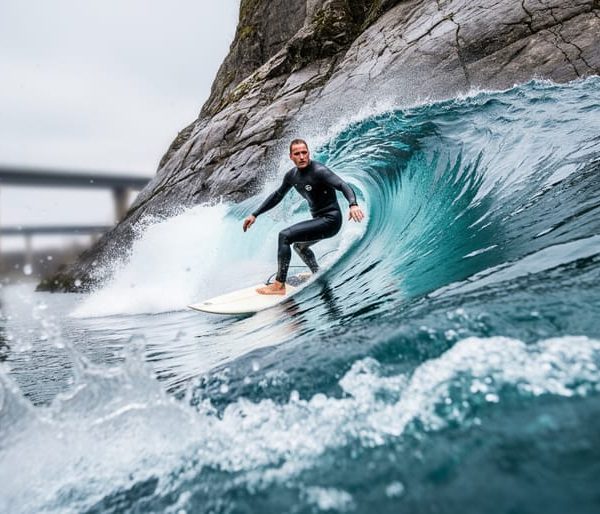
River surfing is surfing’s landlocked cousin, a discipline where you ride a single, stationary wave created by water rushing over rocks, bridge pillars, or engineered features in a river. Instead of chasing swells and paddling back out, you’re locked into one spot where the wave never stops breaking. You get up, you fall, and if you want another go, you walk back upstream and jump in again.
This isn’t just ocean surfing moved to freshwater. The culture that’s grown around river waves over the past few decades has its own rhythm, its own heroes, and its own way of doing things. River surfers have learned to see possibility where most people see just moving water. They’ve built communities around single waves that fire 24/7, creating lineups that function more like skate parks than traditional surf breaks. There’s no dawn patrol necessary, no tide charts to check, no frustrating flat spells that last for weeks.
What pulls people to rivers is different from what pulls them to the ocean. Some are landlocked surfers desperate for any rideable wave. Others are kayakers or whitewater enthusiasts who discovered they could ditch the boat and stand up. Many are drawn by the accessibility: you can surf the same wave during your lunch break that you surfed yesterday, and you’ll likely see the same crew cheering you on both times.
The community values are distinct too. River surfers tend to be makers and builders, often working together to improve waves or advocate for new ones. The vibe is less territorial than many ocean breaks, partly because everyone’s taking turns on the same small piece of real estate. You learn names quickly. You learn to wait your turn and give solid rides their due respect.
The River Wave: Understanding What You’re Actually Surfing
Here’s the thing ocean surfers don’t get until they see it firsthand: in a river, the wave doesn’t move. You do all your surfing in one spot while thousands of gallons rush beneath your board every second. It’s the opposite of everything you learned paddling out at the beach.
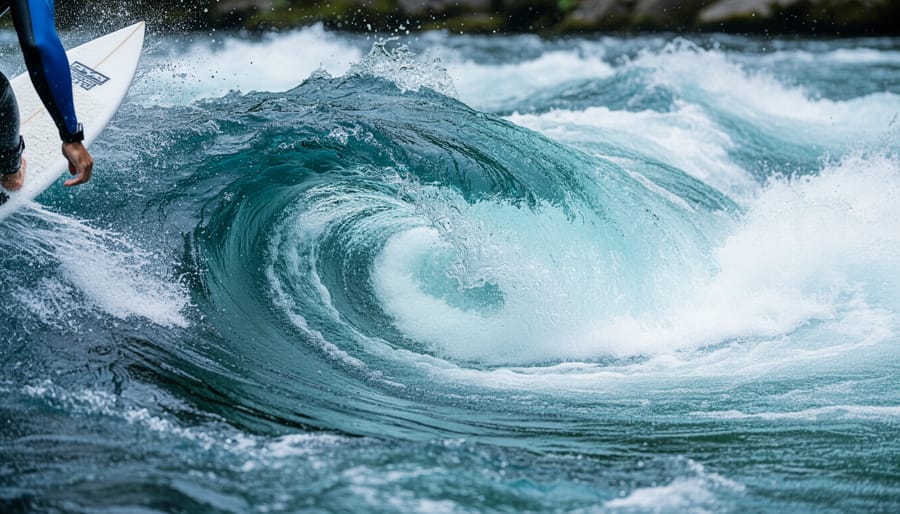
Ocean waves are rolling energy moving through water. They build offshore, travel toward land, and break once before they’re gone. River waves are stationary, water flows over an obstacle on the riverbed, creating a standing wave that holds its shape as long as the current keeps moving. You’re not riding the wave’s forward motion; you’re balancing on a hydraulic force that’s constantly trying to flush you downstream.
The mechanics matter because they change everything about how you surf. When water accelerates over a rock ledge or drops in elevation, it creates what hydrologists call a hydraulic jump. The fast-moving water hits slower water below, forcing it upward and back on itself. That upward push creates the wave face you’re riding. Change the flow rate, more water after spring snowmelt, less during summer, and the wave’s size, shape, and personality shift completely.
Here’s where terminology helps decode what you’re looking at:
- Standing Wave
- A stationary wave that forms when moving water hits an obstacle; unlike ocean waves, it doesn’t travel but holds its position as water flows through it.
- Hydraulic
- The powerful recirculating water feature created by a river drop or ledge; it can create a surfable wave face or a dangerous keeper depending on its characteristics.
- Green Wave
- A clean, glassy standing wave without whitewater or foam, formed by smooth water flow over a gradual feature, the ideal for long rides and technical surfing.
- Pour-Over
- A wave where water falls vertically from a ledge before forming the wave face, creating a curtain effect and often a more challenging, dynamic ride.
- Hole
- A recirculating hydraulic feature where water flows back upstream, which can trap objects and swimmers; some holes are surfable, others are dangerous keepers to avoid.
- Eddy
- The calm pocket of slower or reverse-flowing water beside the main current, used as a safe zone to rest, wait your turn, or enter and exit the wave.
Geology shapes personality. A wave breaking over smooth granite behaves differently than one formed by jagged basalt. The riverbed’s angle, the width of the channel, even seasonal debris caught on the bottom, all of it tweaks how water moves and what kind of ride you get. River surfers become amateur geologists and hydrologists by necessity, reading water the way ocean surfers read swell reports.
This is why you can surf the same river wave hundreds of times and still find new lines, new tricks, new challenges. The wave’s right there, waiting, every single day.
From Counterculture to Community: How River Surfing Found Its Identity
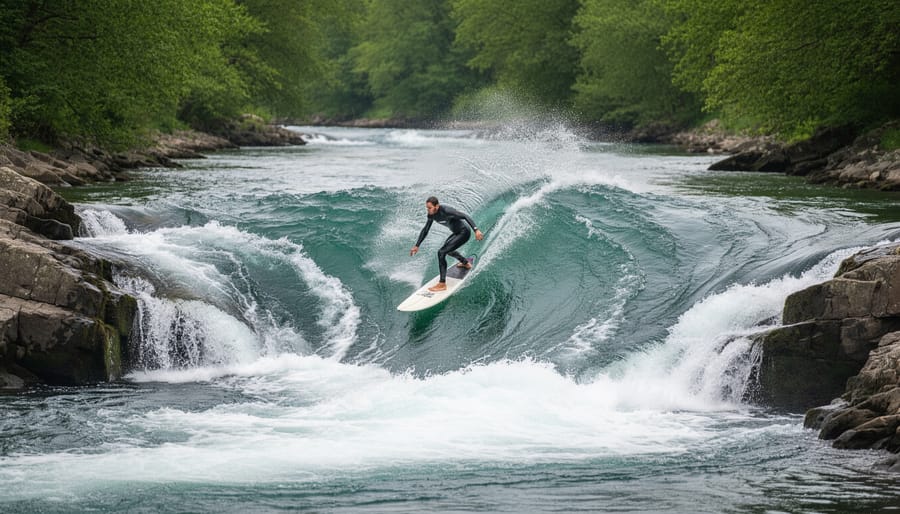
River surfing didn’t emerge from surf competitions or beach culture. It started with a few stubborn souls in Munich who looked at the Eisbach, a narrow, frigid channel cutting through the city, and saw possibility where everyone else saw a concrete ditch. In the early 1970s, when surfing a standing wave seemed absurd to most surfers, these early adopters grabbed their boards and jumped into a static wave beneath a bridge in the Englischer Garten. They weren’t chasing perfect barrels or tropical beaches. They were creating something entirely new, born from urban rebellion and a refusal to let geography dictate their passion.
Those first Eisbach surfers faced hostility. City officials banned the activity repeatedly, calling it dangerous and disruptive. Locals complained. But the surfers kept showing up, session after session, year after year. They developed their own techniques for the relentless push of the standing wave, learned to read water flow instead of swell forecasts, and built a tight community around this one unlikely spot. By the 1980s, the Eisbach had become legendary in underground surf circles, proof that waves didn’t need an ocean.
Across the Atlantic, North American pioneers were making their own discoveries. In the 1990s, kayakers and rafters who understood river hydraulics began experimenting with surfboards on natural standing waves in Montana, Idaho, and British Columbia. These weren’t city rebels, they were outdoor adventurers who saw the connection between whitewater features and surfable waves. They approached rivers with environmental awareness baked in, understanding that healthy watersheds and natural flow patterns created the waves they loved.
This environmental consciousness became central to river surfing’s identity. Unlike ocean surf culture’s sometimes fraught relationship with localism and territorialism, river surfers recognized early that their waves depended on clean water, thoughtful river management, and collaboration with broader communities. When Boise built North America’s first purpose-built river surf park in the early 2000s, it wasn’t just about recreation, it was about urban river restoration and demonstrating how cities could reconnect with their waterways.
By the 2010s, river surfing had spread globally. Munich finally legalized the Eisbach in 2010, acknowledging what surfers had known for decades. New waves appeared in Calgary, Montreal, and across Europe. Each community carried forward that original DIY spirit, building relationships with city planners, testing new wave designs, welcoming newcomers. What started as counterculture had become a movement defined by collaboration, environmental stewardship, and the simple joy of riding an endless wave.
The Unwritten Rules: River Surfing Etiquette and Values
Walk up to any river wave during peak hours and you’ll notice something unexpected: surfers chatting on the bank, cheering each other on, and actively helping newcomers figure out their entry. This isn’t some utopian fantasy, it’s standard river surfing culture. The limited real estate of a single standing wave has forced river surfers to develop etiquette that’s less about guarding territory and more about sharing an experience that literally can’t move.
The rotation system is sacred. Unlike ocean surfing where you paddle out and jockey for position, river waves operate on a clear, visible queue. You take your turn, ride until you fall or yield, then head to the back of the line. Simple as that. The transparency of this system, everyone can see exactly where they stand, removes most of the tension and aggression that plagues crowded ocean breaks. You’re not competing for every wave; you’re waiting for your guaranteed shot.
Respect for locals runs deeper here, too, but it’s earned through stewardship rather than aggression. The people who’ve been riding a particular wave for years are typically the ones who organize river cleanups, advocate with local authorities for access, and teach newcomers the safest entry and exit points. They’re not gatekeepers; they’re caretakers. Show up ready to learn about that specific wave’s quirks, where the current runs strongest, which rocks to avoid, when water levels make it too dangerous, and you’ll find locals eager to share knowledge rather than stink-eye.
Here’s what every river surfer should internalize from day one:
- Always watch the rotation and know your place in line before entering
- Exit the wave promptly when you fall, don’t swim back up and cut the line
- Ask locals about hazards, entry points, and current conditions before your first session
- Pack out everything you brought in, plus trash you find along the riverbank
- Yield to someone clearly more skilled if the wave can handle progressive tricks
- Never leave gear or trash that could end up in the river
Environmental consciousness isn’t a side value in river surfing, it’s foundational. These waves exist because of specific ecological and hydrological conditions. River surfers understand that pollution, water diversion, or habitat destruction could eliminate their wave entirely. Most river surfing communities organize regular cleanups, monitor water quality, and actively participate in watershed conservation efforts. You’ll find more river surfers at city council meetings about water management than at any ocean break.
The collaborative vibe extends to progression, too. Because everyone’s riding the same wave repeatedly, you watch each other improve in real time. Someone lands a new trick, and the whole lineup erupts. You’re not just sharing space; you’re sharing a training ground where everyone’s growth is visible and celebrated.
What Makes a River Surfer: The Skills and Mindset
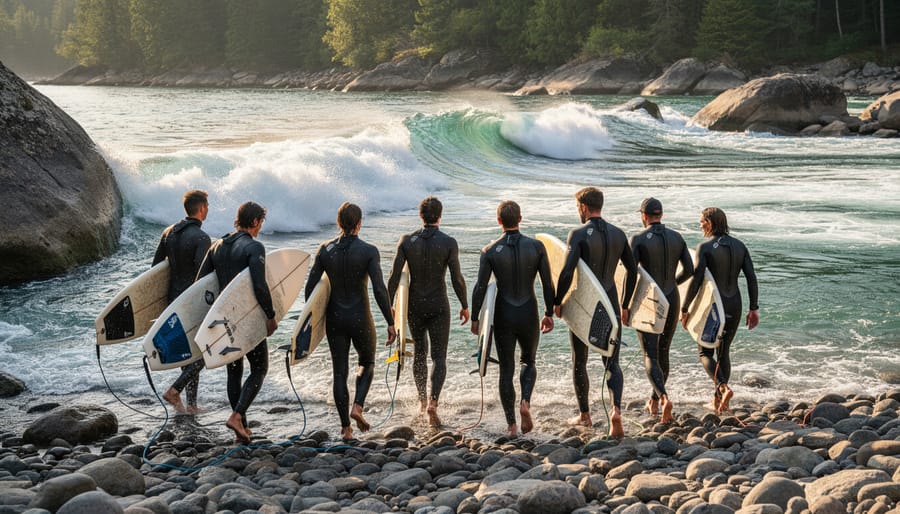
Standing on a river wave demands a different body entirely. Where ocean surfing rewards explosive paddling and a single decisive pop-up, river surfing asks you to hold a perpetual conversation with moving water. Your knees stay bent, your weight shifts constantly, micro-adjustments every second as the current pushes, pulls, and tries to flush you downstream. This isn’t a wave you catch once. It’s a wave you negotiate, again and again, for as long as your legs hold out.
The pop-up happens fast, almost violent. You paddle into position, grab the board, and spring up before the hydraulic spits you out. There’s no gradual glide down a face. You’re either on the wave or you’re swimming. Ocean surfers visiting rivers often blow their first dozen attempts because they’re waiting for momentum that never arrives. River waves don’t cooperate. They demand commitment.
Once you’re up, the real learning begins. Your stance narrows. Your focus locks onto reading the boil lines, the foam pile, the sweet spot where the wave’s push balances your board’s glide. Move too far forward and the current buries your nose. Hang back and you slide off the shoulder into flat water. The feedback loop is instant and unforgiving, which makes progression addictive. You’re not waiting fifteen minutes between waves to test a theory. You wipe out, swim back, try again in two minutes.
This repetition breeds a different mentality. River surfers don’t chase variety. They chase mastery. The same wave, day after day, becomes a canvas for refinement. You dial in a cutback until it’s effortless, then add a snap. Then a 360. The meditative quality sneaks up on you, the rhythm of paddling back, popping up, holding your line, falling, repeating. It’s surfing as practice, not hunt. The wave isn’t going anywhere, so neither is your potential to improve.
Gear That Gets You on the Wave
Walk into any river surfing lineup and you’ll notice the gear looks different. There’s a reason for that: river surfing beats the hell out of equipment, and the waves demand boards that can handle constant abuse while giving you the control ocean boards simply can’t provide in standing water.
River boards are built like tanks compared to their ocean cousins. Most clock in between 4’6″ and 5’6″, a full foot or more shorter than what you’d ride in the ocean. They’re thicker through the middle (often 2.5 to 3 inches), with more volume packed into less length. The rails are beefier, the construction more robust. You’re not gliding across open water; you’re carving the same turbulent section repeatedly, often with rocks lurking inches below the surface.
| Feature | Ocean Board | River Board | Why It Matters |
|---|---|---|---|
| Length | 5’8″, 6’4″ | 4’6″, 5’6″ | Tighter turns in stationary waves |
| Thickness | 2″, 2.5″ | 2.5″, 3″ | More float in aerated water |
| Construction | Lightweight PU/epoxy | Heavy-duty epoxy/carbon | Survives rock impacts and constant stress |
| Fin setup | Thruster or quad | Single or twin (removable) | Less snag risk; easier to adjust hold |
That durability-first mindset extends to everything else. Wetsuits run thicker than ocean standards because alpine rivers stay cold year-round, 4/3mm minimum, often 5/4mm in places like Montana or the Alps. You’re not paddling to warm up; you’re standing in 50-degree water for extended sessions.
Safety gear is non-negotiable in ways ocean surfers might find excessive. A helmet isn’t a maybe, it’s standard equipment. You’re surfing near concrete, rocks, and sometimes rebar. Personal flotation devices matter too, especially on bigger waves or when you’re still learning to read hydraulics. Some spots won’t let you in the water without one.
The culture’s relationship with gear reveals its values. River surfers talk about which boards can take a beating, not which look coolest on Instagram. They mod and repair rather than replace. This isn’t fashion-forward surf culture; it’s pragmatic riders solving real problems with equipment that works, session after session, rock strike after rock strike.
Spotlight: Voices from the Lineup
The heart of river surfing beats through the people who’ve dedicated themselves to this landlocked pursuit, each bringing their own vision of what surfing a standing wave can mean.
Dieter “Eisbach” Deventer practically wrote the book on urban river surfing. He’s been riding Munich’s Eisbach since 1981, when getting in the water meant dodging police and angry park officials. “We didn’t have permission, we didn’t have wetsuits that worked in cold water, and we definitely didn’t have crowds cheering us on,” he says. Now in his sixties, Dieter still surfs the wave he helped legitimize, mentoring newcomers and documenting the spot’s evolution. His approach embodies the DIY ethos that defines river surfing, if the wave doesn’t exist yet, create it. If the rules say no, persist until they say yes. He sees river surfing as fundamentally democratic: “The ocean chooses who surfs well based on timing and paddle strength. The river wave is there for everyone willing to wait their turn.”
Across the Atlantic, Martina Chen turned river surfing into environmental action. After discovering the Boise River wave in 2019, the former ocean surfer recognized that healthy rivers create better waves. She founded River Pulse, a nonprofit connecting river surfers with watershed restoration projects. “We’re literally surfing the lifeblood of our landscapes,” Martina explains. “When agricultural runoff or drought affects water quality and flow, we feel it immediately on the wave.” She’s mobilized river surfing communities in six states to monitor water quality, remove invasive species, and advocate for environmental flows. For Martina, every session is both joy and responsibility.
Then there’s Jake Cortes, who’s pushing what’s physically possible on a standing wave. The 28-year-old from Montreal holds the record for consecutive backflips on Quebec’s Habitat 67 wave, eleven rotations before finally washing off. “River surfing rewards pure progression,” he says. “You can attempt the same trick fifty times in an hour, making micro-adjustments each time. That feedback loop doesn’t exist in the ocean.” His Instagram videos blend skateboarding’s trick mentality with surfing’s flow, attracting a younger generation who see rivers as performance labs rather than ocean substitutes.
These three represent different paths into river surfing, yet they share one thing: they chose rivers not because oceans weren’t available, but because rivers offered something oceans couldn’t.
Where Rivers Come Alive: Global Hotspots in 2026
River surfing has evolved from a handful of legendary spots to a worldwide network of waves, each with its own character and community. In 2026, these locations represent the full spectrum of what river surfing offers.
Munich’s Eisbach remains the spiritual home of river surfing. This cold, fast wave in the English Garden draws surfers year-round, maintaining the no-nonsense etiquette that’s influenced river spots globally. Show up, wait your turn, and surf hard, the rotation moves quickly, and the locals expect commitment. The wave’s consistency and the city’s acceptance of surfers as part of the landscape make it a pilgrimage site for river surfers worldwide.
Boise’s whitewater park shows what intentional design can create. The adjustable wave system lets surfers dial in conditions, and the park atmosphere has fostered a welcoming, progression-focused community. Summer evenings see lineups that mix experienced surfers helping newcomers alongside kids learning their first cutbacks. It’s become a model for urban river development that prioritizes access over exclusivity.
Skookumchuck Narrows in British Columbia offers the opposite experience, raw, powerful, and demanding respect. This tidal bore requires precise timing, solid skills, and an understanding of ocean-strength forces in a river setting. The surfers who chase Skookum share a different mentality: they’re explorers who want the challenge that only nature can provide.
Montreal’s Habitat 67 wave and similar urban installations in cities like Munich and Denver prove river surfing doesn’t need wilderness. These spots have created lunch-break sessions and after-work communities, bringing surfing into daily life rather than relegating it to weekend escapes. Each location develops its own rhythm, but all share that core river surfing value: making the most of what the water gives you.
Getting Your First River Wave: A Beginner’s Path
Your first river wave is closer than you think, and the community’s ready to help you get there.
Start by searching online for river surfing groups in your area. Facebook, Instagram, and local paddling forums are goldmines for finding where surfers gather. Most river surf spots have dedicated communities that post conditions, organize sessions, and welcome questions from newcomers. Don’t be shy about reaching out. River surfers remember their first wobbly rides and genuinely want to share the stoke.
Before you paddle out, watch the lineup from shore. You’ll learn more in twenty minutes of observation than in hours of reading. Notice the rotation system, how surfers enter and exit the wave, and where the safest zones are. This reconnaissance isn’t just about safety, it shows respect for the spot and its regulars.
Here’s your practical roadmap to that first session:
- Connect with a local river surfing group or instructor who knows the wave’s quirks and dangers, never surf a river wave alone your first time.
- Rent or borrow appropriate gear: a river-specific board (shorter and thicker than ocean boards), helmet, and PFD are non-negotiables.
- Choose a beginner-friendly wave with mellow features, good exit routes, and active supervision, avoid powerful hydraulics or waves with obstacles.
- Practice your pop-up on land, focusing on quick, controlled movements since river waves demand immediate balance.
- Enter the lineup during off-peak hours when experienced surfers can offer guidance without the pressure of a crowd.
- Expect short rides initially, five seconds on a standing wave is an achievement worth celebrating.
Most river surf communities offer informal mentorship. Ask questions between sets, and you’ll find surfers eager to decode the current, suggest stance adjustments, or lend a wetsuit. The river’s constant presence creates patience that ocean lineups sometimes lack.
Your first successful ride might last three seconds. You’ll probably fall backward, swallow water, and get flushed downstream. But you’ll also understand immediately why people drive hours to surf the same stationary wave, and why this community keeps growing. The river doesn’t care about your ocean credentials, everyone starts as a beginner here, and that levels the playing field beautifully.
River surfing stands apart not because it failed to replicate ocean surfing, but because it created something fundamentally different, a culture built around patience, precision, and community rather than conquest and territory. Where ocean surfers chase fleeting opportunities across vast horizons, river surfers return to the same wave day after day, refining their craft in a practice that feels closer to meditation than competition.
This focus on mastery over a single feature rather than accumulation of waves has shaped everything about river surfing culture. The rotation systems, the collaborative vibe, the willingness to coach strangers through their first ride, these aren’t just polite customs. They reflect a shared understanding that everyone’s here for the same reason: to connect with that perfect, unchanging wave and push themselves a little further each session.
The environmental consciousness runs deeper too. When your surf spot is literally in your backyard, dependent on specific flow rates and clean water, stewardship stops being abstract and becomes personal. River surfers know their local hydrology, advocate for watershed health, and build relationships with water managers because their sport demands it.
If you’ve been curious about river surfing but hesitated because you don’t live near the coast, or because you assumed it was just a compromise, reconsider. This isn’t ocean surfing’s consolation prize. It’s a distinct discipline with its own rewards, its own progression, and its own tight-knit community of people who chose rivers precisely because they offer something the ocean never could.
Find your local wave. Show up with humility and enthusiasm. You might discover that landlocked surfing was what you wanted all along.