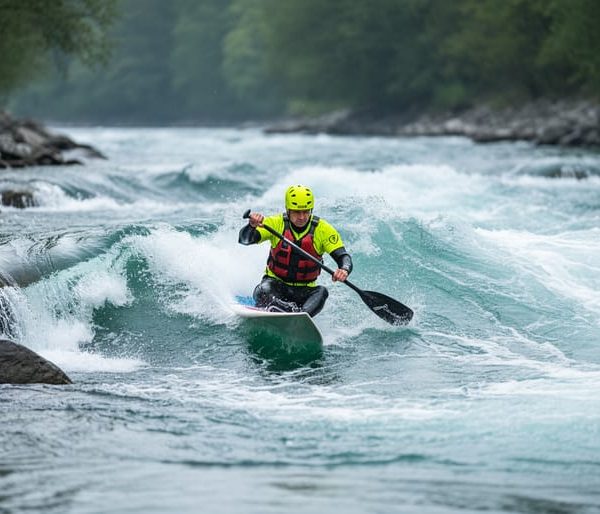
The single biggest mistake anxious river surfers make is focusing on the danger instead of the system. Most river surfing incidents happen because riders treat standing waves like ocean breaks, ignoring the hydraulics, strainers, and entrapment hazards unique to moving water. If you’ve had a close call or feel paralyzed by fear every time you paddle out, you’re not alone, and the fix is simpler than you think: learn to read the river’s specific hazards, not just the wave.
Here’s your quickest diagnostic check: Can you identify the keeper hydraulic behind your wave, spot visible strainers upstream, and describe the river’s exit route before you even touch the water? If not, that’s your starting point. Understanding river vs ocean risks transforms panic into preparation.
This guide walks you through exactly how to diagnose what’s making you nervous, fix your safety approach step by step, and develop the prevention habits that seasoned river surfers rely on. You’ll learn to spot the warning signs that separate manageable risk from genuine danger, and crucially, when to walk away without shame. River surfing demands respect, but it doesn’t have to be terrifying once you understand what you’re really dealing with.
Safety note: If you can’t swim strongly in current, lack proper flotation, or are surfing alone, stop here. Address those baseline gaps before troubleshooting technique.
Recognizing River Surfing Hazards: What You’re Up Against
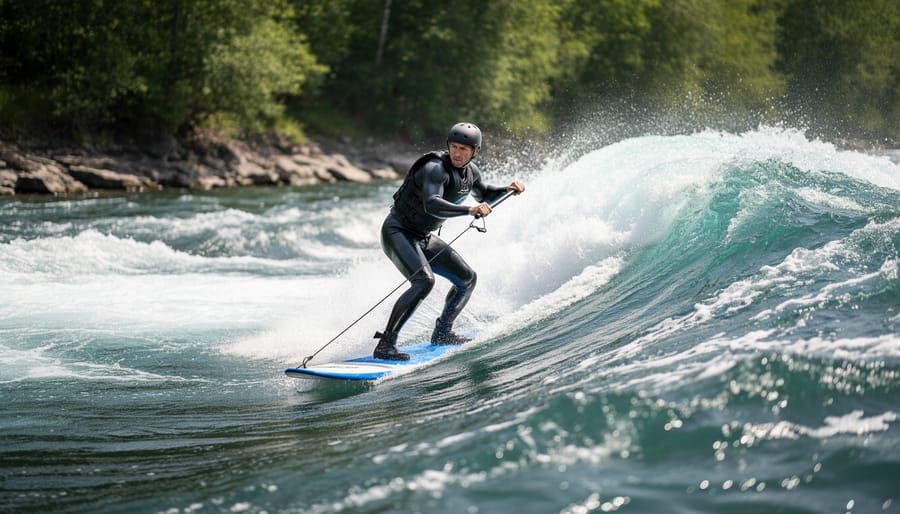
Before you can fix a safety problem on the river, you need to recognize what you’re dealing with. River hazards don’t always announce themselves with warning signs, and what looks calm from shore can turn sketchy once you’re in the water. Learning to spot these risks early, whether you’re scouting a new wave or already in the lineup, gives you the power to make smart decisions before things escalate.
Hydraulic Features and Keeper Holes
If you see foam boiling back upstream toward a wave or notice a distinct hole that seems to hold debris on the surface, you’re looking at a hydraulic. These recirculating features range from playful surf spots to dangerous keepers. The warning signs: whitewater that churns in place rather than washing downstream, logs or branches stuck in one spot, or a wave that looks “sticky” when other surfers try to exit. If you’re already in the water and feel yourself being pulled back toward the wave face repeatedly, that’s your body telling you the hydraulic is stronger than your paddling power.
Strainers and Submerged Obstacles
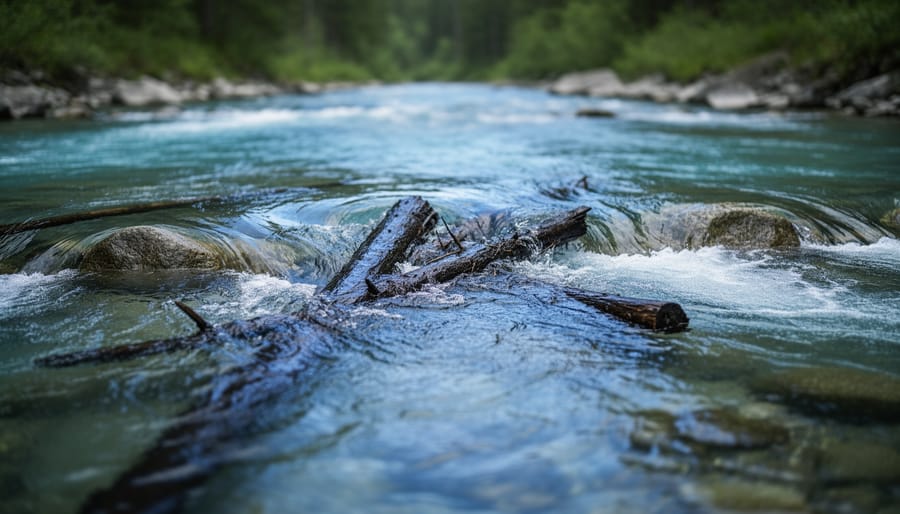
Fallen trees, bridge pilings, rebar, and rocks create entrapment zones where current pushes you into an obstacle you can’t escape. From shore, look for branches breaking the surface, unusual current patterns that deflect around a spot, or eddies that form behind invisible objects. In the water, sudden changes in current direction or unexpected turbulence often signal something lurking below.
Cold Water Exposure
Hypothermia sneaks up fast in river environments. Early symptoms include uncontrollable shivering, difficulty with fine motor skills like unzipping your wetsuit or gripping your board, slurred speech, and poor decision-making. If you’re losing dexterity in your hands or your thinking feels foggy, you’re already too cold to be surfing safely.
Foot Entrapment and Current Strength
This one’s deceptive because calm-looking water can generate tremendous force. Watch for warning signs:
- Current moving faster than a walking pace makes standing up dangerous
- Difficulty maintaining position while swimming indicates powerful flow
- Visible pressure waves forming around stationary objects show current strength
- Rocky riverbeds with gaps between stones create foot-trap potential
- Sudden numbness or pain in feet suggests developing circulation issues from cold
The current always wins in a strength contest. If you’re fighting hard just to hold your position, that’s the river telling you to reassess. Equipment issues like a twisted leash, loose PFD strap, or helmet shifting out of position might seem minor on land, but in moving water they compound quickly into real problems. Check your gear before you paddle out, because mid-session adjustments in current are way harder than they should be.
Why River Surfing Feels More Dangerous: Root Causes Behind the Risks
Hydraulic Dynamics and Keeper Holes
A standing wave might look stable, but underneath that glassy surface lies a hidden recycling system that can trap even strong swimmers. When fast-moving water hits an obstacle, a rock shelf, a low-head dam, or a sudden drop, it creates a hydraulic feature where the surface current flows backward toward the base of the wave. The water beneath keeps flowing downstream, creating a washing machine effect that holds objects and people in a continuous loop.
These features are hydraulic “keeper holes” because they genuinely trap whatever enters them. Unlike ocean waves that release you after the wipeout, a river hole pulls you back in. The danger multiplies when the hole’s width spans the entire river, leaving no escape route to the sides. Your buoyancy works against you here, your PFD keeps pushing you to the surface where the backwash grabs you again.
Not all holes are keepers. A “friendly” wave has a weak backwash that releases surfers quickly, often with an escape channel to one side. Keeper features typically form at uniform drops with strong, smooth backwash and little aeration. While river surfing is nothing like ocean surfing in many respects, understanding why it’s safer starts with recognizing which hydraulic formations pose real danger versus ones designed for play.
Obstacles You Can’t See
Rivers hide dangers beneath the surface that ocean surfers never encounter. Submerged rocks create impact zones that can knock you unconscious or break bones when you’re swept through a rapid or fall from a wave. Logs and branches act as strainers, water flows through them, but your body doesn’t, pinning you underwater with tremendous force.
Urban rivers present particularly nasty surprises: rusted rebar jutting from old bridge pilings, shopping carts wedged into the riverbed, and construction debris that’s been there for decades. These obstacles shift position with changing water levels, meaning a spot that was safe last month might be hazardous today.
The real danger is that flowing water obscures these threats. What looks like clean, open water from shore often conceals hazards just below the surface. Depth perception becomes unreliable in moving water, and murky conditions make visual inspection impossible. One moment you’re riding a wave, the next you’re tangled in submerged debris you never saw coming.
Underestimating River Force
Looking at a gentle river from shore, it’s easy to assume the current won’t be much different from paddling in a lake. That assumption gets people into trouble fast.
Water moving at just 3 mph carries enough force to knock an adult off their feet. At 6 mph, a moderate river flow, the pressure against your body becomes impossible to fight directly. Most river waves form in currents moving 8-12 mph, creating forces that feel like being shoved by multiple people simultaneously.
Beginners consistently misjudge this power because they’re used to ocean conditions where you can duck-dive or paddle through waves. In a river, you’re always fighting the current’s continuous push. What looks like a mellow two-foot wave might be sitting in water moving fast enough to pin you against rocks or sweep you 50 yards downstream in seconds.
The physics are unforgiving: force increases exponentially with speed, not linearly. Double the current speed, and you’re dealing with four times the pressure. That’s why experienced river surfers talk about respecting the flow, it’s not hyperbole, it’s survival math.
How to Assess and Navigate River Hazards Safely: Step-by-Step
Pre-Session Scouting Protocol
Before you paddle out, invest serious time watching the wave from multiple vantage points. Walk both banks if possible to spot hazards invisible from a single angle. Look upstream and downstream for at least 50 yards beyond your target wave, scanning for strainers, logjams, or submerged obstacles that could trap you if you get flushed through.
Check the water level against visual markers like exposed rocks or bridge pilings. If locals mark gauge levels on nearby structures, use those references to understand whether conditions are rising, falling, or stable. Rising water changes everything within hours, turning manageable features into dangerous traps.
Study the wave itself for at least ten minutes. Watch how foam patterns move. Does water recirculate back upstream behind the wave, suggesting a keeper hydraulic? Are there boils or weird surface disruptions indicating submerged rocks? Notice where other surfers position themselves and where they avoid.
Identify your escape routes before entering. Where will the current take you if you fall? Can you swim to shore safely from that downstream zone, or will you get pinned against obstacles? Trace multiple exit paths in your mind.
Take photos or video if you’re unfamiliar with the spot. You’ll want references for comparing future sessions at different water levels.
Safe Entry and Positioning Techniques
Getting to the wave safely is half the battle in river surfing. The approach and positioning separate confident river surfers from those who get swept into trouble.
Start your entry upstream of the wave, never directly beside or below it. Wade or paddle in from the side, angling across the current rather than fighting straight against it. Keep your eyes on strainers and use eddies as rest stops. If you can’t reach the eddy behind the wave without crossing downstream hazards, don’t go.
Position yourself in the upstream eddy, not floating in the current. Plant your feet if wading depth allows, or paddle into the calm pocket behind obstacles or riverbanks. From this safe zone, you can observe the wave’s behavior, plan your move, and rest between attempts.
When you’re ready to drop in, commit quickly, hesitation gets you pushed downstream into hazard zones. Paddle or push hard toward the wave’s shoulder, aiming for the cleanest part of the feature. If the current pulls you off-line toward a strainer or rock pile, abandon the attempt immediately and work back to your upstream eddy.
Never position yourself downstream of other surfers. If someone loses their board or gets flushed, you become the next obstacle.
What to Do When Things Go Wrong
If you get caught in a hydraulic or keeper hole, your first instinct might be to fight your way upstream, resist this urge. Instead, tuck into a ball, protect your head with your arms, and let the current push you deep. Hydraulics recirculate at the surface but often release you once you sink below the churning zone. If you’re still trapped after going deep, try swimming aggressively toward either side of the feature rather than straight downstream. The edges of most hydraulics have weaker recirculation and offer your best escape route.
For foot entrapment, one of the most dangerous river scenarios, never try to stand up in moving current if you’re unsure of the bottom. If your foot does get wedged between rocks, immediately lean back and get your body horizontal on the surface, even if it means your head goes underwater briefly. This body position reduces the force of water pinning you down. Signal for help by waving both arms overhead in a clear, repeated motion, and stay calm to conserve oxygen.
When your leash breaks or your board gets away, prioritize your own safety over gear. Swim on your back with feet downstream, using your legs as bumpers to push off obstacles. Keep your head up and oriented downstream to spot hazards. If you’re exhausted and can’t make shore, grab onto a stable rock or log to rest, but never wrap rope or leash material around your body.
Have a communication system with your crew before you paddle out. Three sharp whistle blasts or repeated arm waves signal serious trouble requiring immediate assistance.
Essential Safety Gear and Why It Matters
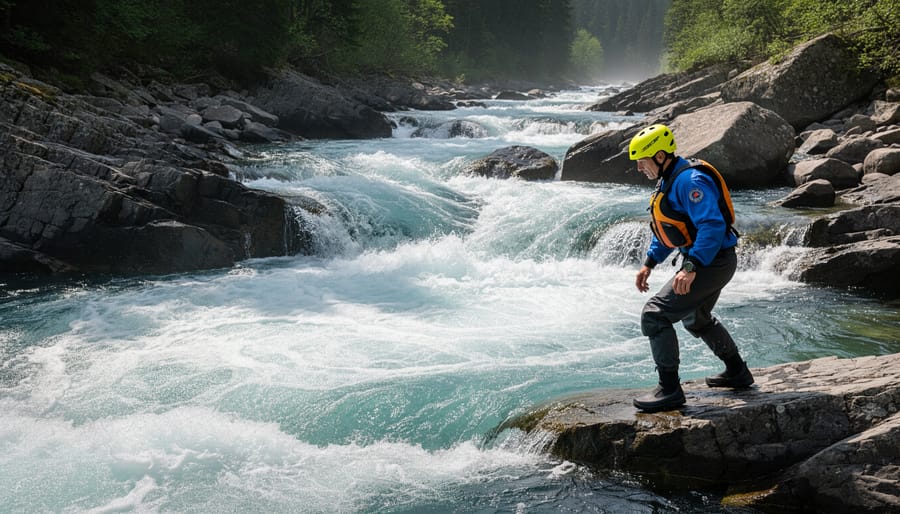
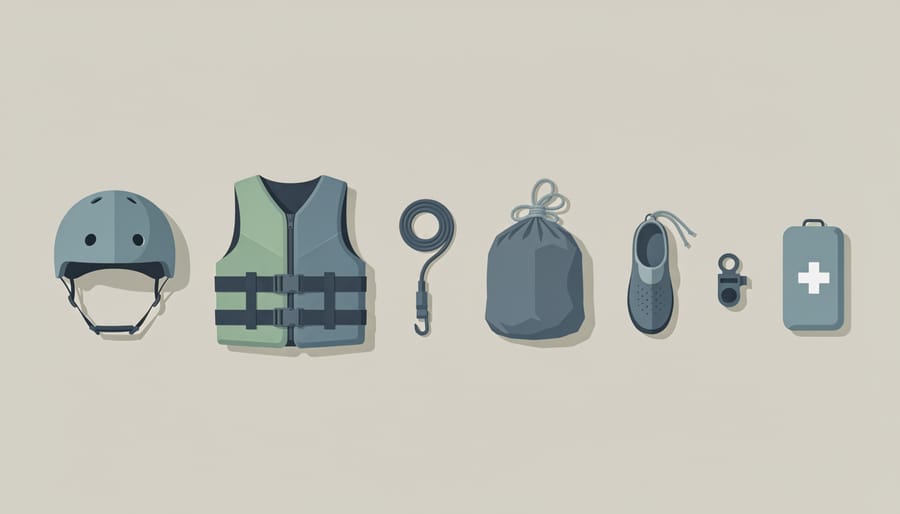
Ocean surfers can get away with just a board and a leash. River surfers can’t. Each piece of safety gear directly addresses the hazards we just covered, cold water shock, head impacts, entrapment, hydraulic recirculation, and the need for rescue capability. This isn’t about looking the part; it’s about creating layers of protection between you and the specific dangers rivers present.
Start with the non-negotiables. A whitewater-rated helmet protects against the rocks, logs, and submerged debris that rivers hide beneath their surface. Look for one with full ear coverage and good drainage, you’ll be underwater more than you expect. Your PFD (personal flotation device) needs to be a proper river vest, not a kayaking jacket or ocean buoyancy aid. River PFDs are cut shorter to avoid interference with your waist when sitting, and they provide flotation positioned higher on your torso to keep your airways above water in moving current.
Your leash situation is completely different than ocean surfing. Standard surf leashes become death traps in rivers, they’ll wrap around submerged obstacles and hold you underwater. You need a quick-release leash specifically designed for river use, with a handle you can grab and pull even when you’re panicking and can’t see. Many river surfers skip the leash entirely on certain waves, accepting the swim to retrieve their board rather than risking entrapment. Know which approach your local break demands.
| Gear Type | Protects Against | Key Features | Priority Level |
|---|---|---|---|
| Whitewater Helmet | Head impacts with rocks, logs, riverbed | Full ear coverage, drainage holes, secure chin strap | Essential, never optional |
| River PFD | Drowning in current, hydraulic recirculation | Short cut, high flotation placement, rescue handles | Essential, never optional |
| Quick-Release Leash | Entrapment on submerged obstacles | Easy-pull handle, river-specific design, belt-mounted | Essential if using a leash |
| Cold Water Wetsuit | Hypothermia, cold water shock | 4/3mm minimum, sealed seams, proper fit | Essential below 60°F water |
| River Knife | Leash/rope entanglement | Blunt tip, serrated edge, secure sheath on PFD | Recommended for all sessions |
| Throw Bag | Assists swimmer rescue | 70+ feet of floating rope, quick deployment | One per group minimum |
Cold water demands serious attention. Rivers rarely exceed 65 degrees even in summer, and many productive surf waves run through snowmelt in the 40s and 50s. A 4/3mm wetsuit minimum is essential, not for comfort, but because cold water shock can trigger gasping and disorientation the moment you hit the water. Booties protect your feet from sharp rocks during entry and exit, which is where most river surfing injuries actually occur.
The river knife clips onto your PFD and exists for one purpose: cutting yourself free from entanglement. It needs a blunt tip so you don’t stab yourself while fumbling for it underwater, and a serrated edge that saws through leash material in one motion.
Finally, someone in your group needs a throw bag. This is a rope stuffed into a bag that you can throw to a swimmer in trouble, giving them something to grab while you pull them to safety from shore. It’s not about your own session, it’s about being able to help when someone else gets in trouble.
Building River Reading Skills: Prevention Through Knowledge
The best insurance against river disasters isn’t just good gear, it’s learning to read water like a language. Experienced river surfers can glance at a wave and spot hydraulic danger, identify eddy lines that signal safe zones, and interpret subtle surface boils that reveal submerged obstacles. This skill doesn’t come from YouTube tutorials or blog posts alone. It develops through repeated observation, pattern recognition, and paying attention to what happens when conditions change.
Start by studying your local river at different flow levels throughout the season. Notice how wave shape transforms as discharge increases. Watch where debris collects after storms. Document which features become more dangerous at higher flows and which mellow out. Take photos from the same vantage point weekly to build a mental catalog of how water level affects wave character and hazard zones.
Water surface clues reveal what’s happening below. Smooth, glassy patches often indicate deep water, while choppy, confused sections suggest shallow rocks or obstacles creating turbulence. Upstream boils, water surging up from below, mark where current deflects off something substantial on the riverbed. Horizon lines (where you can’t see downstream) frequently signal drops or hydraulics worth investigating carefully before committing.
Flow data becomes your friend. Learn to check USGS gauge readings for your river and correlate specific discharge numbers with surfable conditions versus danger zones. Many river communities maintain informal databases or social media groups sharing beta about optimal flows, hazards at different levels, and recent changes to wave features.
Watching others surf a wave before you paddle out isn’t timid, it’s tactical intelligence. Note where experienced surfers enter, which zones they avoid, and how they position themselves. Ask questions. Share what you’ve observed. The river surfing community thrives on knowledge exchange, and attending local surf events connects you with people who’ve already made the mistakes you’re hoping to avoid.
River Surfing Safety Wisdom from the Community
The best safety lessons don’t come from manuals, they come from surfers who’ve learned the hard way. We reached out to experienced river surfers across North America to hear what keeps them safe on standing waves.
“My non-negotiable is never surf alone, especially on a new wave,” says Marcus Chen, who’s been riding Montana’s rivers for twelve years. “I watched a buddy get recirculated in what looked like a mellow hole. Having someone on shore with a throw bag saved his life. Now I don’t paddle out unless someone’s watching who knows what to do.”
Emma Rodriguez from Colorado emphasizes the importance of humility: “I’ve surfed ocean waves for twenty years, but rivers humbled me fast. The power is completely different. My rule now is to spend three sessions just watching a new wave before I touch it. I look for strainers upstream, check what happens when someone falls, see where the current pushes people.”
Jake Morrison shared a close call that changed his approach: “Got my foot wedged between two rocks in knee-deep water. The current was strong enough that I couldn’t pull free. Taught me two things, always wear a helmet because I went face-first trying to free myself, and keep a river knife accessible. I managed to signal my buddy who helped lever the rocks apart.”
The common thread in every river wave story we heard: respect the environment, invest in proper gear, and lean on your community’s knowledge. These surfers didn’t learn to read rivers overnight, but they’re still here because they treated every session as a chance to learn rather than prove something.
Frequently Asked Questions
Can I use my ocean surfboard for river surfing?
Yes, but shorter boards work better for most river waves since you’re surfing in place rather than riding down a wave face. Look for boards around 5’6″ to 6’2″ with extra volume for stability in chaotic current.
How do I know if a river wave is safe for my skill level?
Watch experienced surfers for at least 15 minutes before paddling out. If you see people swimming frequently, getting flushed downstream, or nobody surfing despite good wave shape, that’s your signal the spot exceeds your abilities.
What’s the most important piece of safety gear for river surfing?
A properly fitted helmet comes first because head impacts with rocks or submerged obstacles are the most common serious injury in river surfing. Your PFD is a close second, especially in cold water or high flow conditions.
Should I surf rivers alone?
Never surf alone, especially when learning. Rivers change constantly and even experienced surfers can get into trouble quickly. Having someone onshore who knows where you are and can throw a rope makes the difference between a scary moment and a tragedy.
These questions come up constantly in river surfing communities, particularly from ocean surfers making the transition. The gear question matters because showing up with the wrong setup wastes sessions and creates unnecessary risk. Knowing when to sit one out prevents the scenarios covered earlier in the troubleshooting sections. And the buddy system question addresses the single biggest preventable factor in river surfing accidents, isolation when something goes sideways.
River surfing carries real risks, but they’re not insurmountable. Every experienced river surfer you meet has stood exactly where you are now, nervous, uncertain, maybe rattled by a close call or overwhelmed by what they don’t know. The difference between them and beginners isn’t fearlessness; it’s systematic knowledge, proper gear, and healthy respect for moving water.
You’ve now got the framework to assess hazards, understand what causes them, and take concrete steps to surf rivers more safely. That’s not theoretical, it’s actionable intelligence you can apply this weekend. Start conservative. Scout thoroughly. Wear your helmet and PFD every session, no exceptions. Choose forgiving waves with clear exit routes while you build your river reading skills.
The river surfing community thrives because experienced surfers remember their early anxieties and actively help newcomers navigate them. Find your local crew. Ask questions. Watch where they position themselves and why. Learn the specific quirks of your home wave before chasing new spots.
Progress takes time, and that’s good. Rushing leads to exactly the scenarios we’ve covered. Patience keeps you surfing for decades rather than one scary season. Respect the river, trust the process, and let your confidence grow as your skills do. The stoke is worth it.